
Interview with Qi Chen — The Cognitive Scientist Redefining AI Productivity
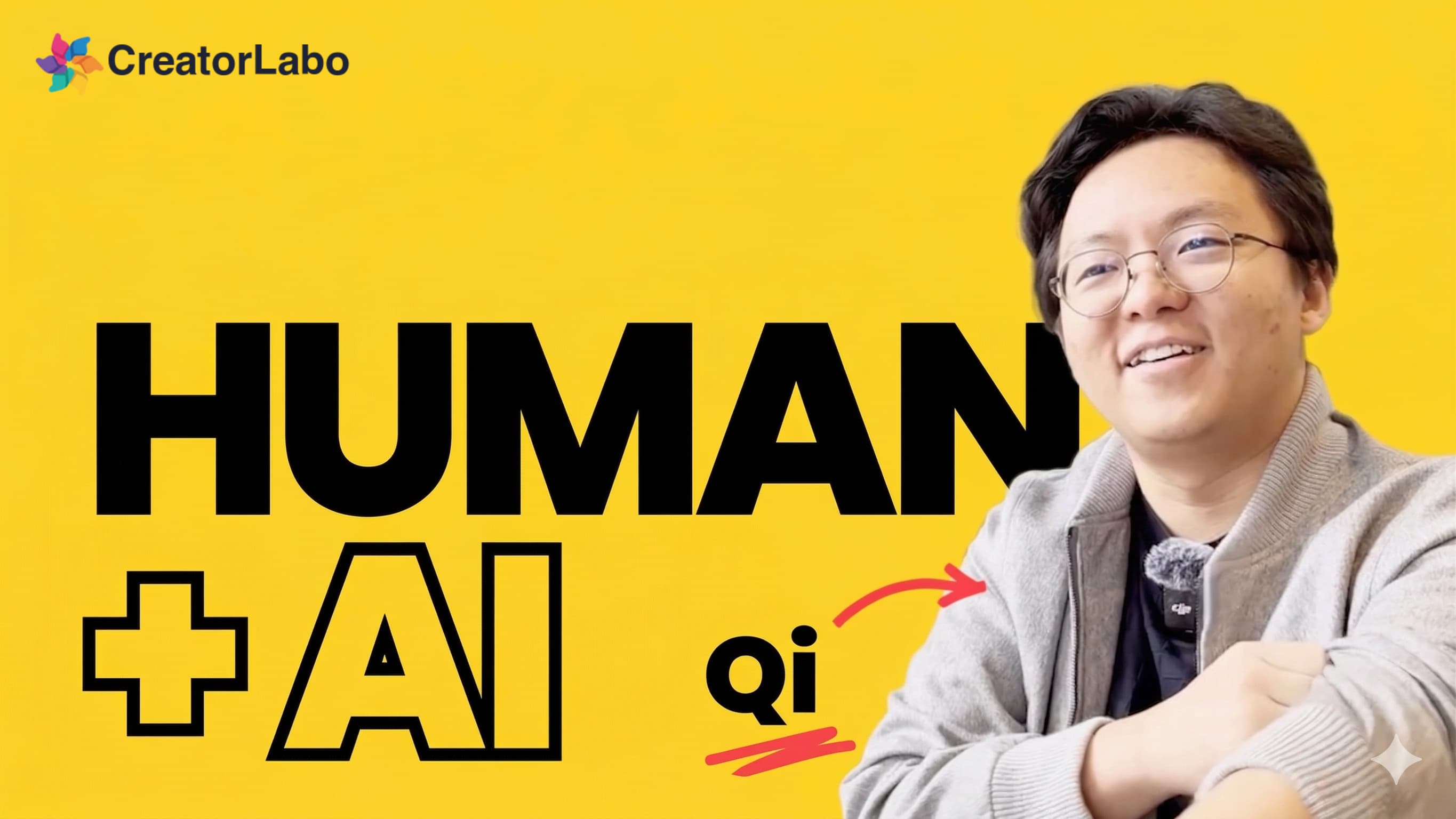
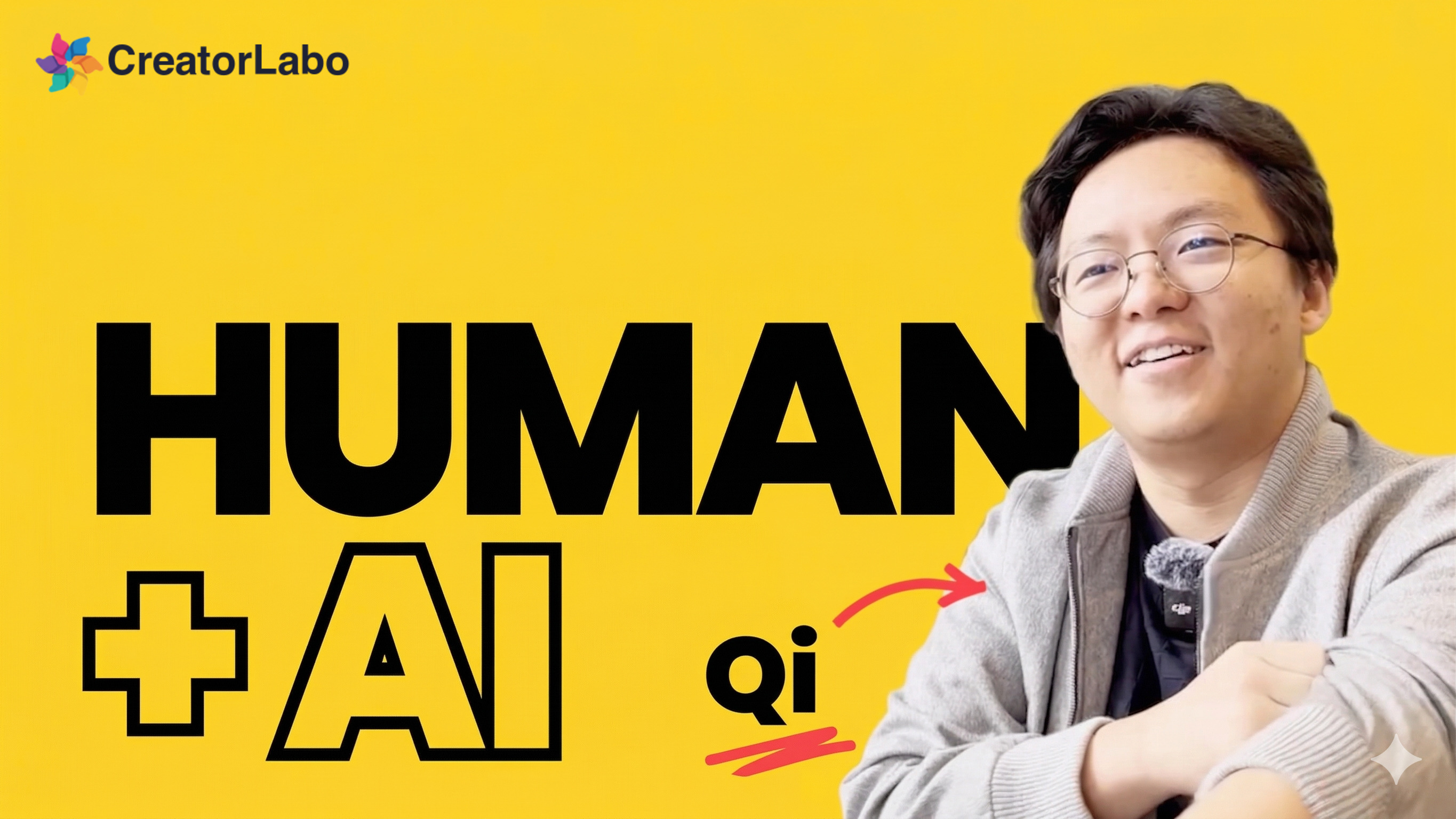
"People don't think in apps -- they think in flows. Tools should adapt to that." -- Qi
An interview with Qi -- cognitive science researcher and first-time founder -- on AI, focus, and building at the intersection of many worlds.
Qi later joined CreatorLabo as a mentor at Minna Hackathon 2025, presented by TRAE at the Fujitsu Uvance Kawasaki Tower on December 20, 2025 — bringing his unique perspective on cognition and AI to the next generation of builders.
From Academia to Accidental Breakthroughs
When most founders talk about AI assistants, the conversation quickly devolves into a checklist of features: meeting summaries, code suggestions, note-taking bots. But Qi's journey into AI started in a place that rarely produces startup founders -- nearly a decade inside a PhD program in cognitive science, a discipline that forces you to understand how humans interpret information, structure ideas, and infer patterns from limited data.
His early research explored how people perceive style in written characters. At one point, he built systems capable of generating complete typefaces from only 10--20 examples -- not to design fonts, but to study how humans abstract structure from fragments. That skill would later become the backbone of his approach to machine learning and product design.
But the turning point came during an internship in Japan. He was tasked with building a Japanese ASR (Automatic Speech Recognition) model from scratch -- despite never having worked with speech, audio, or phonetics before. With the methodical mindset of a cognitive scientist, he broke the problem down and rebuilt it piece by piece.
The result was astonishing: his model eventually became the most widely used open-source Japanese ASR system built entirely from scratch.
"That moment showed me I could enter a completely new field and still produce something meaningful, as long as I understood the patterns beneath it."
Why Today's AI Assistants Still Get Work Wrong
As AI tools matured through 2023--2024, Qi noticed something that felt obvious yet rarely discussed: modern work is built on constant context-switching. Developers bounce between meetings, IDEs, documentation, tutorials, Slack channels, dashboards, and browser tabs. Every transition breaks concentration.
"AI tools today are designed for individual apps," Qi explains. "But humans don't think that way."
He became increasingly aware of how intrusive meeting bots were. Users described them as uncomfortable, even surveillance-like.
"Meeting bots change the atmosphere instantly. People don't like being recorded or observed. The tool becomes the distraction."
Instead of pushing AI deeper into meetings, Qi and his co-founder experimented with a quieter idea: an ambient assistant that sits alongside your entire workflow, understanding transitions, maintaining continuity, and reducing friction without inserting itself into calls.
The insight came from watching real users -- and from observing his own unusual way of working.
The Founder Who Works With AI Eight Hours a Day
Qi doesn't talk about AI the way most people do. For him, AI isn't a chatbot. It isn't a productivity tool. It isn't a notetaker.
It's a colleague.
"Claude is basically my coworker. I talk to it for eight hours a day."
He uses Claude the way some founders use a whiteboard or a long walk: thinking out loud, structuring ideas, reflecting on decisions, and testing assumptions. He feeds it long-term context. He relies on it for planning. He uses it to reason through uncertainties.
His usage was so heavy that he repeatedly hit Claude's four-hour limit and eventually upgraded to Claude Max simply to keep the conversation going. This wasn't productivity hacking -- it was necessity.
Qi's workflow represents a shift many founders are just beginning to experience: AI not as a tool, but as a second cognitive stack.
Building Toward an AI That Understands the Whole Day
Qi's prototype for an ambient AI assistant emerged naturally from his own habits. Instead of bots that intrude into specific tasks, he imagines AI that quietly supports the entire workflow.
Today's assistants are fragmented because they mirror the apps they live inside. Qi believes the next generation will be defined not by features but by continuity -- the AI that understands and preserves human flow.
"People don't think in apps -- they think in flows."
It's a simple statement, but one that reframes the entire landscape of AI productivity tools.
Advice for Young Founders
After moving from research to startup building, Qi learned hard lessons about speed, clarity, and humility.
He laughs when describing his early product decisions.
"First-time founders often build what they find interesting, not what the market needs. I did that too."
His advice is grounded, not glamorous:
- Talk to users earlier than you think.
- Ship before you feel ready.
- Don't fall in love with the prototype.
- Let the problem teach you what to build.
- Find a pace you can sustain for years, not weeks.
And most importantly:
"Be patient with yourself. Building clarity takes time."
When we resumed our conversation a few weeks later, Qi had been through a string of meetups and late-night building sessions. The conversation shifted from philosophy to practice — how his startup was evolving, and the personal rhythms that shape his work.
"Every transition in my day is a reset -- a chance to think differently." -- Qi
The Transition Phase: Rethinking the Product and the Process
When we resumed the second half of the interview, Qi had just returned from a string of meetups, events, and late-night writing sessions. The past six months had changed more than he expected -- not only in his startup, but in how he thought about building itself.
The first part of his story focused on how he built Japan's most widely used open-source ASR model and why he now works with Claude as a full-time colleague. But Part 2 moves into a different terrain: what happens when a founder begins to rethink the direction of their product, their habits, and even their day-to-day cognitive rhythms.
When I ask him how his startup has evolved since we last met, he leans back and answers with characteristic precision.
It's been almost a year since we began building. And the more we talk to users, the clearer the gaps become -- not just in our product, but in how people actually work.
Those gaps forced him to reconsider what "product" even meant for an AI-first startup. In Part 1, we talked about his belief that AI shouldn't intrude into calls or generate more clutter. In Part 2, he expands on how their thinking shifted toward deeper questions of workflow continuity and cognitive load.
Asking Better Questions: What Do Users Actually Need?
Qi admits that in the early days, he and his co-founder fell into the classic first-time founder mistake of building what felt intellectually interesting.
But after a year of conversations with users -- from engineers to researchers to indie hackers -- patterns became visible.
People weren't struggling to do tasks. They were struggling to move between them.
Transitions are where people lose the most energy. You can be productive inside a task, but the switch between tasks destroys your rhythm.
This realization pushed them to revisit core assumptions. Instead of building an assistant that lives in a single app window, they started exploring how to support the invisible parts of work: the mind shifts, the contextual resets, the way your thinking changes depending on who you just talked to or what you just looked at.
Qi frames it simply:
Users don't want another tool. They want less cognitive friction.
And that meant re-evaluating customer acquisition, product positioning, and how they communicate value.
What used to be a feature-focused pitch evolved into a narrative about preserving workflow -- something far more relatable to developers and researchers who live inside dozens of tabs a day.
The AI-Native Lifestyle: Splitting Days, Resetting Minds
One of the most intimate parts of the interview was Qi's personal rhythm -- something he rarely discusses publicly.
He reveals that for nearly ten years, he's had a habit of taking long naps in the middle of the day, effectively splitting his day into two separate cognitive cycles.
I literally treat my day as two days. After I wake up from a nap, everything resets. It's a psychological 'new morning.'
This isn't laziness -- it's intentional cognitive design.
The first half of the day is exploratory: reading, brainstorming, planning. The second half is execution-driven. The nap becomes the boundary between two mental modes, allowing him to restart with clarity rather than drag the morning's mental noise forward.
The habit began long before his startup, back when he was doing research in the U.S. and spending evenings collaborating with Japanese teams. The time zone mismatch created two "shifts" by necessity, but Qi eventually realized the structure gave him a cognitive advantage.
He smiles as he explains it:
When I wake up for the second half, I can think from zero again. It's like my brain reboots.
This practice blends surprisingly well with his AI-native workflow.
Becoming "AI-Native" Without Realizing It
As we get deeper into the conversation, Qi shares something unexpectedly personal: for a long time, he didn't realize his relationship with AI was fundamentally different from others.
When Claude released its Max plan, something clicked.
Before that, Qi constantly ran into usage limits -- four hours a day was nowhere near enough for someone who treats AI as a cognitive partner rather than an occasional assistant.
When they launched the Max plan, I felt like the world finally caught up to how I work. I suddenly became a 'normal' user.
I joke that he might be the first person I've met who lives a genuinely AI-native lifestyle. Qi laughs, but doesn't deny it.
AI is not just helping him work faster -- it's shaping how he thinks, structures ideas, and plans his day. And in this part of the conversation, that becomes increasingly clear.
The more Qi talks about transitions, naps, rhythms, and daily resets, the more his connection with Claude feels less like software and more like extended cognition.
Mapping Connections: People, Ideas, and Serendipity
Near the end of the interview, Qi shares a surprising detail. Whenever he meets new people, he writes their names on a board -- not as a memory system, but as a way of mapping relationships.
As we talk, he explains how he often discovers unexpected connections between seemingly unrelated elements: a founder's background, a photographer's eye, a researcher's habit, or a new acquaintance from a meetup.
Every new person changes the shape of the map. You realize their role isn't fixed -- it depends on the context you connect them to.
It's a cognitive scientist's version of networking: observing how concepts, people, and domains interact over time.
This kind of thinking -- relational, dynamic, pattern-driven -- is exactly why his approach to AI is so unusual. His mind doesn't see silos; it sees systems.
Summary
Qi's story doesn't fit neatly into typical founder archetypes. He isn't the stereotypical hacker. He isn't the polished operator. He isn't the Silicon Valley wunderkind. He's something more interesting: a cognitive scientist who builds, experiments, and collaborates with AI in a way that feels like a preview of the future.
From creating Japan's top open-source ASR model without prior experience, to working side-by-side with Claude for hours a day, to designing AI tools that aim to reduce -- not increase -- cognitive load, Qi is exploring what it means to build at the intersection of research, intuition, and deep curiosity.
Key themes from the full conversation:
- How the startup evolved through deeper user understanding
- Why "transitions" are the hidden cost in modern work
- How Qi splits his day into two cognitive cycles
- What it means to live an AI-native lifestyle
- How he maps relationships and ideas as interconnected systems
"The pace matters. Not too fast. Not too slow. Just enough to keep learning and building."
It's a philosophy shaped by a decade of thinking about thinking -- and one that may shape the tools many of us use in the years ahead.
Interviewer: Billy Qiu Guest: Qi Chen -- CEO & Co-Founder at Paraparas | PhD Cognitive Science Location: Cafe in Nakameguro, Tokyo, Japan Date: October 26, 2025